Bridge — in-game events and actions for external tools
Palworld's admin REST API can tell you who is online and broadcast to them, but it cannot see what happens inside the game, and it cannot reach into it. The bridge closes both gaps: a Lua mod running under UE4SS publishes in-game events onto the shared data volume and executes actions handed back to it, and the panel re-exposes both over HTTP.
The full list of events and actions — with parameters, stability and which
runtime serves them — is generated from one manifest and lives in
bridge-reference.md. This page is the protocol; runnable
examples live in examples/api/.
The envelope
Every message, in both directions, is one shape:
{
  "v": 2,
  "at": 1785941621,
  "kind": "event",
  "type": "player.death",
  "subject": { "kind": "player", "id": "F8EAA197000000000000000000000000", "name": "Löyly" },
  "data": { "killer": { "kind": "player", "id": "1122…", "name": "Bo" } }
}
kindiseventorresult; results addid(matching your call),ok, anderrorwhenokis false.subjectis the entity the message is about — always the same shape, always the same id. A player'sidis theirPlayerUIdas 32 hex digits, byte-identical to theplayerIdin the game's own REST API. A subject can carrypositionwhen known.datais the per-type payload. Whatever the type, "who and where" never moves — a consumer that only readssubjectneed not know the type at all.- Fields are only ever added within an envelope version, never removed or
retyped. Match on
v, ignore what you don't know.
Authentication
Programs use API tokens — created on the panel's admin page, sent as one header, revocable, scoped:
Authorization: Bearer palup_…
read tokens can follow events and run queries; write is needed for anything
that changes the game. Tokens can only reach /api/bridge/* — panel
administration stays with the browser session, so a leaked token cannot mint
tokens or restart the server. The cookie login also works on every bridge
endpoint (that is how the panel itself calls them).
Reading events
GET /api/bridge/events?since=<byte-offset>&limit=<1..500>&type=player.chat,player.join
{"events": [ … ], "cursor": 216}
cursor is a byte offset into the event file; pass it back as since. The
endpoint holds no per-client state, so cursors survive a panel restart. Rules:
- The event file is emptied when the game server boots. A cursor past the end
rewinds to the start, and a response
cursorlower than the one you sent is your signal to discard buffered state from the old run. - Responses are capped at 256 KiB and
limitevents — keep calling untilcursorstops advancing. typefilters without affecting the cursor. Unparseable lines are skipped.
player.join carries firstEver, firstSeen and joins. The agent computes
them from its own registry, which outlives the event file — that file is
emptied every boot and so can never answer "have they ever been here" on its
own.
Calling into the game
One verb, whatever the capability:
POST /api/bridge/call
{"type": "player.give_item", "target": "F8EAA197…", "data": {"item": "PalSphere", "count": 5}}
The answer is a result envelope. HTTP status is about the protocol (unknown
type, bad params, missing scope, timeout); ok inside the envelope is about
the game ("player not online"). A call that reaches the game and fails there
is HTTP 200 with ok: false.
The permission state itself has a raw-file door, which is how the Palladium Studio mirrors a live server:
GET /api/bridge/permissions-file            → {"text": "<permissions.config>", "files": […]}
PUT /api/bridge/permissions-file  {"text", "mod"?}  → replaces one, as a hand edit would
files carries the central file and every installed mod's settings.config
({"name", "mod", "text"}); a mod's entry also carries "commands" — the
generated/commands.ref it published — when the agent has written one, which
is how the studio knows a server-side mod's commands without its code. The PUT
writes the central file, or one mod's with "mod" named.
The GET needs the read scope, the PUT write. Prefer the capabilities
(group.set_entry, permission.grant, …) for changes — they keep the game
the single writer and land in the audit log; the PUT exists for what no
capability says, and a running server re-reads the file within seconds.
Discovery is part of the API:
GET /api/bridge/schema
returns every capability with its parameters, stability, and — the part no
static list can give you — whether it is live right now: engine hooks move
between game builds, and the agent reports which ones actually registered.
Generic clients (the panel's own bridge page is one) render forms straight from
this.
Storage
Two stores, and which one owns what follows from where the reader is. The agent
keeps the player registry behind firstEver and every mod's stored data in
.state/palladium.store, and permissions in palladium/permissions.config —
because a mod inside the game process cannot reach anything else, and because
permissions are a thing operators edit. The panel keeps .state/bridge.db for
what only it produces: join/leave sessions, API tokens, and an audit log of
every call. Nothing external ever touches either directly; both are served
through capabilities.
Tags are the persistence primitive for scripts: player.set_tag /
player.get_tag / player.delete_tag survive restarts, so "already got the
starter kit" needs no database on the script's side.
Permissions
Two layers, deliberately separate. Token scopes answer "may this program talk to the API"; permission nodes answer "may this player do this". Nodes are dotted strings with wildcards, resolved per player:
- the player's own overrides (
permission.grant) win outright, - then their groups, highest
weightfirst, - then the default group — the rank of players who are in no group,
- then the node's registered default — deny, if nobody registered it.
The default group is where everybody starts, not a base layer under every rank: its entries answer only for players who hold no other group.
Within one source, an exact node beats chatshop.* beats *, and deny beats
allow on ties.
Mods own their nodes. A mod declares them in its manifest and they are
registered for it — namespaced by the mod's name, each with a description and a
default. A program that is not a mod does the same thing by calling
permission.register itself, one node per call, which is idempotent and
belongs on startup. An operator's change to a default in permissions.config
outranks what a mod asks for. permission.check is the one question everything
asks; the panel's groups and overrides UI is a client for the same
capabilities, and so is the file.
Constraints make one node fine-grained. An entry can carry per-parameter
matchers — {"species": {"in": ["SheepBall"]}}, {"x": {"min": 0, "max":
1000}} — so "may spawn, but only Lamball" or "may teleport, but only inside
the hub" is one grant, not a list. Enforcement is server-side: pass as:
<playerId> on any /api/bridge/call and the daemon resolves the capability
type as a node for that player, matches the call's own parameters against the
winning entry's constraints, and answers ok: false, error:
"permission_denied…" instead of executing. Built-in capabilities register
under the bridge mod with default deny, so acting on behalf of a player
always needs an explicit grant.
Roles. A group can carry a tag (VIP, ADMIN); a player's role is the
tag of their highest-weight tagged group. It rides on served events as
subject.role, and the panel's chat card shows [ROLE] before names when the
option is on. The game's own chat cannot carry it: writing the chat hook's
message parameter faults this UE4SS build (verified live, and the reason
parameter writes are banned in the agent), so roles are visible everywhere the
bridge renders chat and nowhere the game does.
Positions and locations
player.position reads an online player's exact world coordinates from the
engine. location.save / location.list / location.delete keep a named
location book: stand somewhere worth returning to, read the position, save it
under a name, and the panel's teleport form offers it from a picker. Boss-
shaped spawns the world reports (BOSS_*, RAID_*, GYM_* species with a
position) are recorded automatically as source: "boss" — arenas announce
themselves; nobody types coordinates.
Chat commands
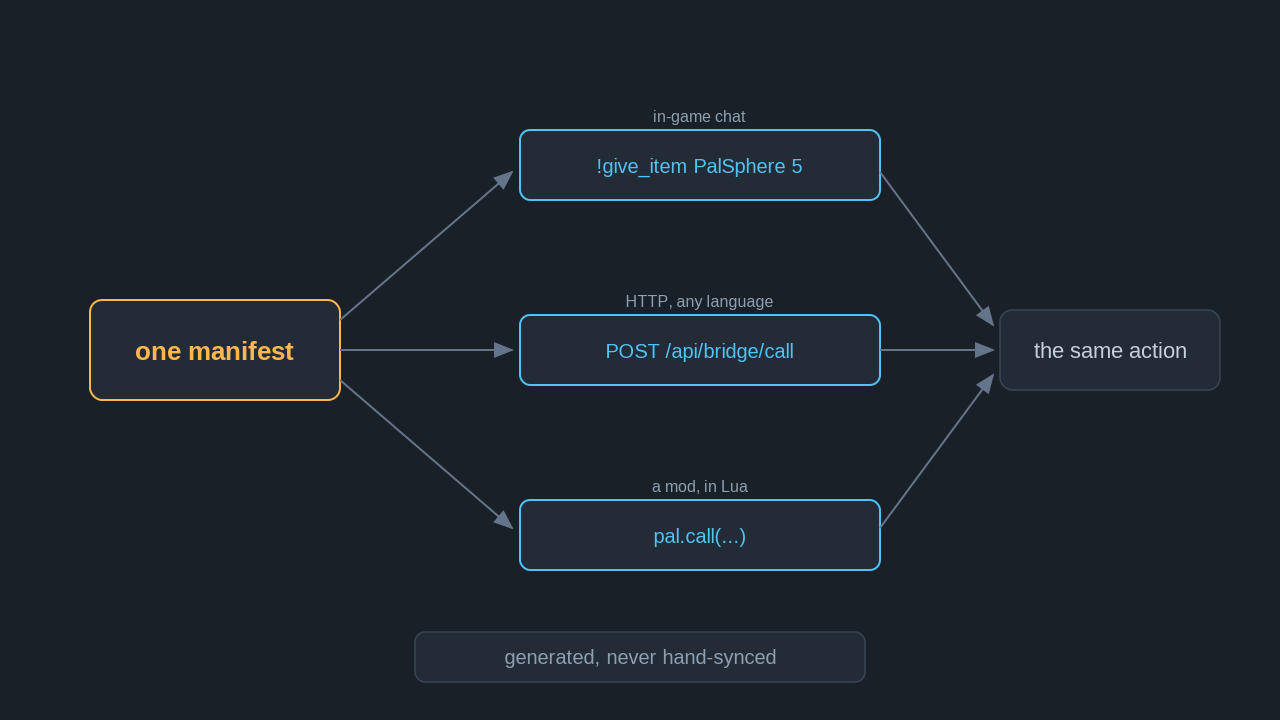
The panel answers !ping itself (broadcasts pong, one command per player per
2 s). Everything beyond that belongs outside: read player.chat, call actions
— chat-shop.mjs adds !kit, !heal,
!gold and !deaths without touching mod, daemon or panel.
The two doors that are not HTTP
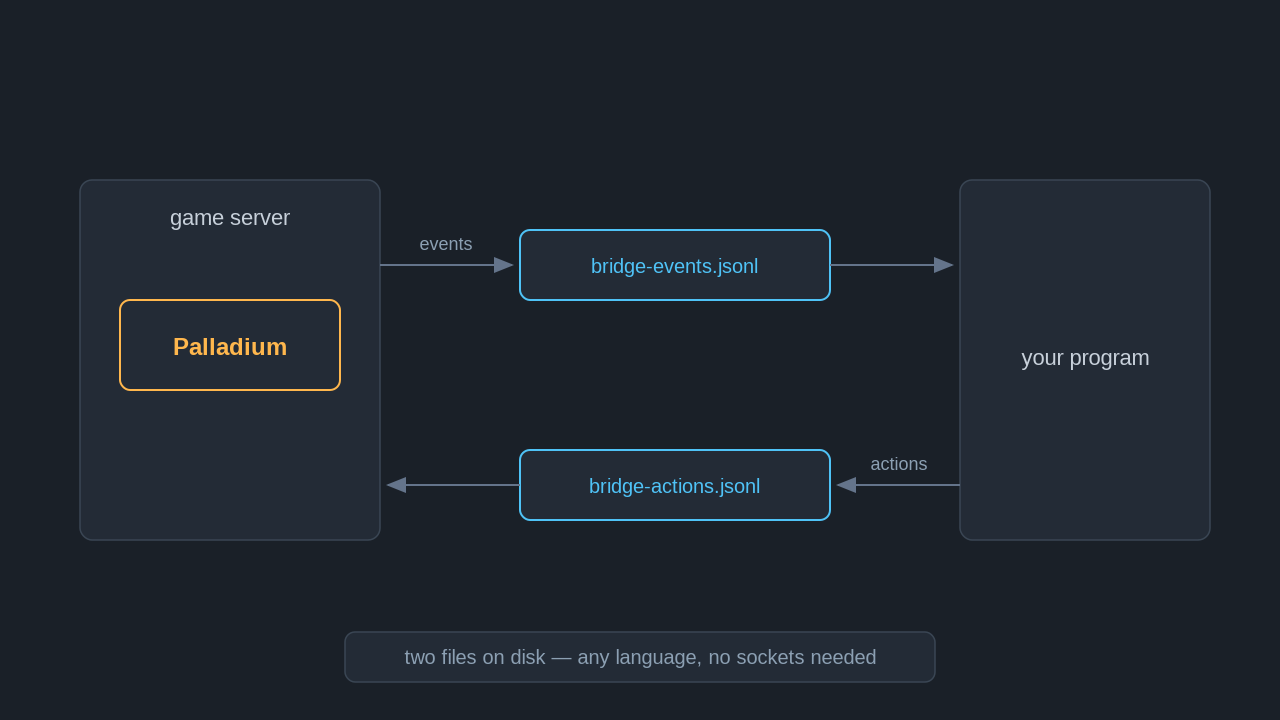
- The event file itself:
/palworld/logs/bridge-events.jsonlon thepalworld-datavolume, for sidecars that prefer tailing a file. Same envelope, minus the daemon's join enrichment. Two writers append to it — the agent, and it is the only writer — always whole lines. - The action queue:
.state/bridge-actions.jsonl, tab-separatedkey=valuerequests consumed by the agent. This is the daemon's private channel; write to it only if you are replacing the daemon.
Worked example: a mod with its own mob and its own permission
The pieces above compose into the standard mod shape. A "summon the camp
guardian" mod, end to end, without touching Palladium's code — one folder in
./mods, a manifest and an entry file:
{
  "name": "Guardian",
  "entry": "main.mjs",
  "permissions": [
    { "node": "guardian.summon", "description": "summon the camp guardian", "default": "deny" }
  ]
}
export const on = {
  'player.chat': async ({ subject, data }, pal) => {
    if (data.message !== '!guardian') return;
    if (!(await pal.can(subject.id, 'guardian.summon'))) return;

    // Any species id works, modded ones included — a species added by a .pak
    // mod is spawnable by its id, and appears in the pal picker once one has
    // been seen in the world.
    const spawned = await pal.call('pal.spawn', subject.id, {
      species: 'BOSS_Anubis', level: 50, rare: true, traits: 'Legend',
    });
    // The result carries the new pal's id — keep it if you want to buff or
    // inspect the guardian later (pal.set_stats, pal.inspect).
    console.log(`${subject.name} summoned ${spawned.data?.id}`);
  },
};
The node is registered from the manifest, so nothing here calls
permission.register. Grant guardian.summon to a group on the permissions
page and the command starts working for its members; the constraint syntax can
narrow it further ("only Lamball", "only below level 20") without changing the
mod. The full format is in docs/mods.md; a program that is a tool
rather than a mod uses the same capabilities over plain HTTP, as in
examples/api/.
Placed pals and wild pals
Two spawns, two natures. pal.spawn places a pal: exact coordinates, exact
level, rarity, traits, and the result carries its id — but it is hand-made
through the NPC manager, absent from the world save, and outside the world's
own wiring. pal.spawn_wild asks one of the world's own spawners near the
player to fire, with the species and level of your choosing (the spawner's
lottery is rewritten for the shot and restored right after): the game itself
wires the newcomer — controller, wild group, combat permission — and
aggressive: true also sets its temperament to attack-on-sight. A wild spawn
lands at the spawner, not at coordinates; that is the trade. pal.force_spawn
is the deprecated name for the same call.
Temperament is why a wild pal of a docile species still only watches you: what
the AI does on discovering someone is the sensor's response preset, per
situation. pal.aggro with sight: true flips every one of them to
battle-anyway on any loaded pal; without it, pal.aggro seeds the hate that
aims a pal at one player.
A placed pal's hostile: true goes as far as possession allows — the wild
monster controller is swapped in, its action loop started, the target
registered as an enemy, the temperament flipped — and the result's
controller field reports how far that got. The wild route is the one the
game itself stands behind; prefer it whenever the exact landing spot does not
matter.
What the engine allows
Hook targets must be native (/Script/…) functions: Blueprint (/Game/…)
targets fault this UE4SS build rather than failing cleanly — registering one,
or even looking a UFunction path up with StaticFindObject, takes the server
down. The agent refuses them outright. Consequences: player.leave is derived
from the agent watching who is still in the world (a few seconds' delay rather
than instant), and Pal-capture events are not available: every native
candidate was probed on a live server — the capture judge's four functions
and the Paldex registration never execute on a dedicated server, and the
achievement counter's update hook faults the process. Item use is the
adjacent event that does work (player.item_use). A capture count is a
separate question with a better answer: player.records reads the running
totals off the record the game keeps per player, so a board that wants
"pals caught" polls for it rather than counting events — and gets an answer
for players who are not online. Capabilities marked experimental in the reference use engine
calls that are unproven against a live player, and may fail with
not_supported rather than doing nothing quietly; the fastcrash guard (three
rapid crashes → unmodded boot) is the safety net around them.
Which functions exist at all differs between builds, so the agent asks the
class chain rather than assuming: a handler calls only shapes the engine
declares, and bridge.probe answers the same question directly —
{"type":"bridge.probe","data":{"on":"params","filter":"stomach"}} lists what
a player's parameter component actually exposes. It reads and calls nothing,
so it is safe to point anywhere. Actions that write a value read it back, which
is why player.set_stats reports applied, unverified and failed
separately: an engine call that returns cleanly has not necessarily done
anything.
Everything outside the agent keys on the envelope and the manifest, not on
engine internals. If an event type stops appearing after a game patch,
/api/bridge/schema and server/UE4SS.log both say which hook died.